AI-enabled planning
Use operational context to plan, simulate, and adjust mission workflows before conditions shift.
Coordinate mission planning, sensing, data fusion, edge intelligence, and autonomous assets inside one secure operational layer.
XRDNA positions Mission Fabric as a software-defined orchestration layer for mission data, AI models, autonomous assets, and operational workflows. The result is a planning and execution environment designed for distributed, high-tempo operations.
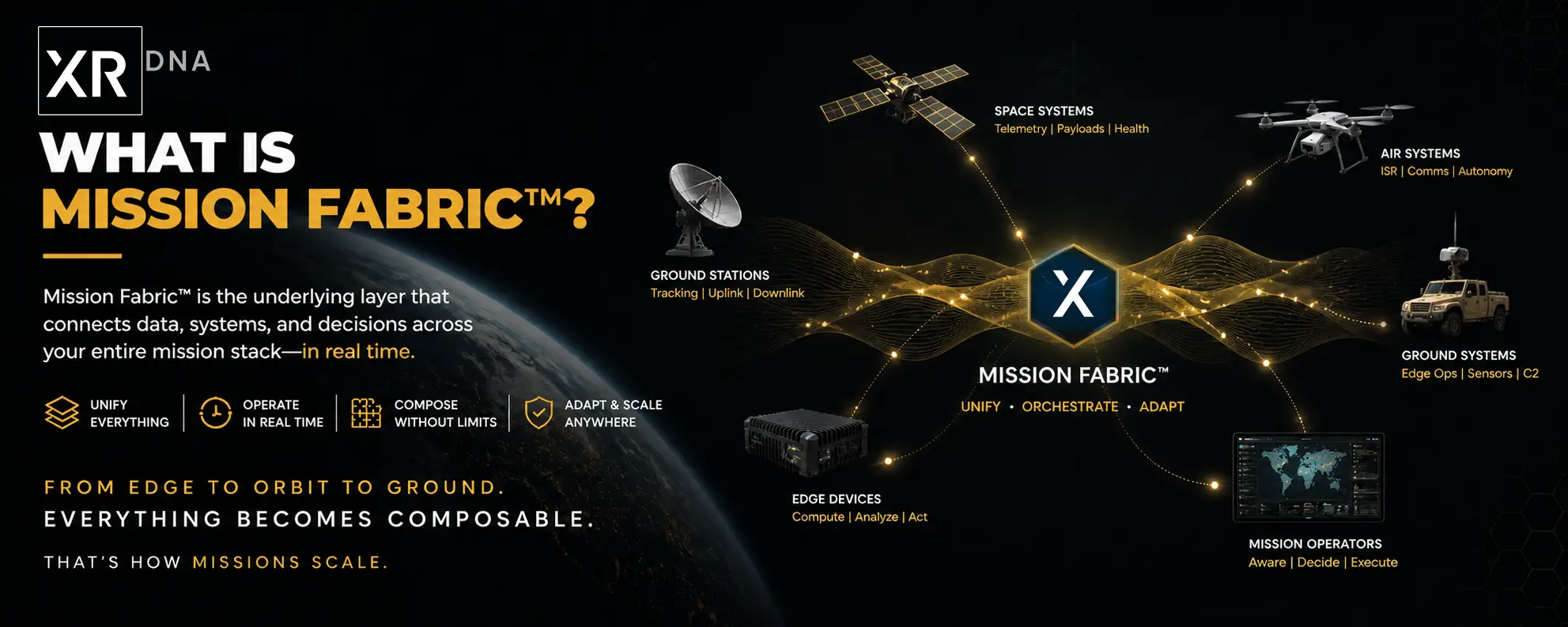
The platform story centers on decision advantage: faster planning, clearer data relationships, resilient access control, and coordination across mixed human-machine teams.
Use operational context to plan, simulate, and adjust mission workflows before conditions shift.
Unify sensor, platform, environmental, and operational inputs into one mission picture.
Deploy decision support across cloud, hybrid, and edge environments where operations demand it.
Support unmanned, autonomous, and human-operated systems in shared mission flows.
Anticipate constraints, risks, opportunities, and likely outcomes before they shape the mission.
Connect existing systems, data sources, and workflows through a modular software layer.
Mission Fabric uses manifests as living containers for routes, assets, identity, access rules, and mission state. They move with the operation instead of staying trapped in static systems.
eva://us.logistics/manifest/sc-alpha-2024
Mission Fabric examples span manifest-driven supply chains, orbital deployment flows, multi-domain operations, and agent-assisted optimization.
manifest: "Supply Chain Alpha"
evaAddress: eva://us.logistics/manifest/sc-alpha
status: active
currentStop: 3 of 7

assets:
 - person: Driver-142
 - thing: Truck-FL-8823
 - thing: Cargo-RFID-9921

controls:
 - live position polling
 - route change approval
 - SoI Social policy
The security model described by XRDNA combines Sphere of Influence policies, geofenced boundaries, timeline-based permissions, approval flows, and observability.
Linked assets can inherit visibility and access rules from the mission or manifest they join.
Coordinate-based controls support geofences, zone entry events, and route deviation awareness.
Permissions can follow mission phases, stop windows, and completion state.
Journey history, asset interactions, and policy decisions remain observable for compliance.
These routes point to XRDNA's own pages for Mission Fabric, spatial infrastructure, eVa, defense, space, and sales or engineering contact.
Product architecture, manifests, AI workflows, APIs, and deployment story.
The identity, resolution, and trust layer for the spatial web.
Elastic Vector Addressing for persistent spatial and temporal identity.
Start a deployment, partnership, or technical integration conversation.
Bring Mission Fabric into defense, aerospace, logistics, industrial, or autonomous-system environments with help from XRDNA's sales and engineering team.